Table of Content
If the home you’re selling is not your primary residence but rather an investment property you’ve flipped or rented out, avoiding capital gains tax is a bit more complicated. The best way to avoid a capital gains tax if you’re an investor is by swapping “like-kind” properties with a 1031 exchange. This allows you to sell your property and buy another one without recognizing any potential gain in the tax year of sale. You can sell your primary residence and be exempt from capital gains taxes on the first $250,000 if you are single and $500,000 if married filing jointly.
Even when your second piece of real estate is converted into your primary home, you will be taxed on part of the gains based on how long the home was used as a second home and not the primary residence. Lastly, you may have the ability to take some of the biggest disappointments in your investing portfolio and use them to offset some or all of your capital gains. There are exceptions for certain situations, such as divorce and military deployment, as well as rules for when sales must be reported.
Capital Gains: How Much Will I Pay?
The brackets are a little bigger for married couples filing jointly, but most will get hit with the marriage tax penalty here. Married couples with incomes of $80,800 or less remain in the 0% bracket, which is great news. However, married couples who earn between $80,801 and $501,600 will have a capital gains rate of 15%. Those with incomes above $501,601 will find themselves getting hit with a 20% long-term capital gains rate. Examples are a home, household furnishings, and stocks or bonds held in a personal account. When a capital asset is sold, the difference between the basis in the asset and the amount it is sold for is a capital gain or a capital loss.
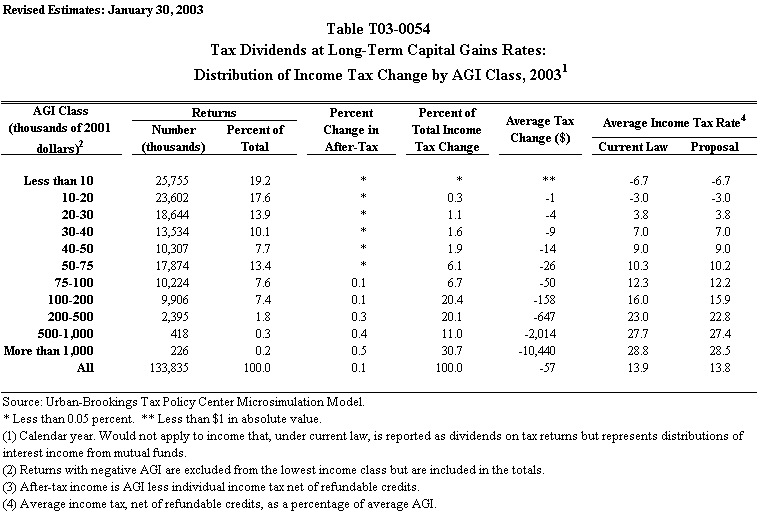
This is an important distinction, because capital gains and ordinary income are taxed at different rates if the capital assets were held for more than a year. Short-term capital gains are taxed as ordinary income according to the taxpayer’s tax bracket, which ranges from 10% to 37% depending on your income. California is generally considered to be a high-tax state, and the numbers bear that out. There is a progressive income tax with rates ranging from 1% to 13.3%, which are the same tax rates that apply to capital gains. The Golden State also has a sales tax of 7.25%, the highest in the country.
What Is The Capital Gains Tax On Real Estate?
The real estate professional must receive certification that these attestations are true. There are ways to reduce what you owe or avoid taxes on the sale of your property. If you own and have lived in your home for two of the last five years, you can exclude up to $250,000 ($500,000 for married people filing jointly) of the gain from taxes. Homeowners often convert their vacation homes to rental properties when they are not using them.

Therefore, if your new spouse sold a home in the past two years, it will prohibit you from being able to sell until their two-year time span expires. The Housing Assistance Act of 2008 was designed to provide relief for homeowners on the edge of foreclosure, yet it could cost the owners when they decide to sell. You have to live in the residence for two of five years before selling it.
When do I pay the capital gains tax on real estate?
Because you owned the car for only six months, it is a short-term capital gain. You have to pay the short-term capital gains tax, which is the same as your regular income tax rate. If you can’t completely avoid the taxes, there are ways to minimize the amount of taxes you pay. Even if you’re used to paying a high capital gains tax rate, double-check your figures when you file your tax-year 2022 tax return . If you’re in a lower tax bracket this year than you were in 2021, you may find yourself paying no tax at all on your capital gains when you file your return in April 2023. Your basis in your home is what you paid for it, plus closing costs and non-decorative investments you made in the property, like a new roof.
Generally, if you hold the asset for more than one year before you dispose of it, your capital gain or loss is long-term. If you hold it one year or less, your capital gain or loss is short-term. To determine how long you held the asset, you generally count from the day after the day you acquired the asset up to and including the day you disposed of the asset.
The exact amount of capital gains taxes is highly dependent upon how long the property was held. If you sell your home for more than what you paid for it, that’s good news. And you may have to pay taxes on your capital gain in the form of capital gains tax. It feels great to get a high price for the sale of your home, but in some cases, the IRS may want a piece of the action.

We do not manage client funds or hold custody of assets, we help users connect with relevant financial advisors. Stepped-up basis is somewhat controversial and might not be around forever. As always, the more valuable your family's estate, the more it pays to consult a professional tax adviser who can work with you on minimizing taxes if that's your goal. A financial advisor can help you manage your investment portfolio.
You may be able to do so, however, on investment property or rental property. If you or your family use the home for more than two weeks a year, it’s likely to be considered personal property, not investment property. This makes it subject to taxes on capital gains, as would any other asset other than your principal residence. Most commonly, real estate is categorized as investment or rental property or as a principal residence. An owner’s principal residence is the real estate used as the primary location in which they live.
Just as individual homeowners might choose to sell their home when their income is at a low ebb, businesses should offset capital gains with capital losses. These include 401 plans, individual retirement accounts and 529 college savings accounts, in which the investments grow tax-free or tax-deferred. That means you don’t have to pay capital gains tax if you sell investments within these accounts. There are some requirements that have to be met to avoid paying capital gains tax after selling your home. Profits earned on the sale of real estate are regarded as capital gains. However, suppose you utilized the property as your principal residence and met specific additional criteria.
You can also add sales expenses like real estate agent fees to your basis. When you sell your primary residence, $250,000 of capital gains (or $500,000 for a couple) are exempted from capital gains taxation. This is generally true only if you have owned and used your home as your main residence for at least two out of the five years prior to the sale. If a property is held for more than one year, gains are subject to the long term capital gains tax rate, which varies based on a taxpayer’s income and filing status.




No comments:
Post a Comment